If your download link is not working, create a support ticket. We will send you a new working download link when we are back.


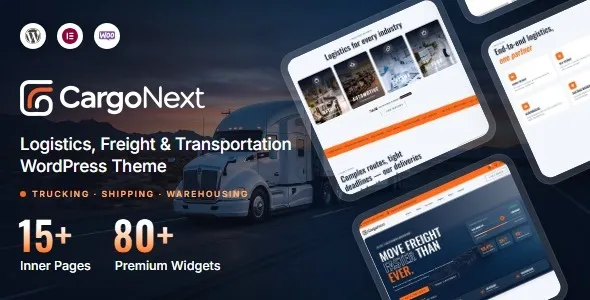
CargoNext – Logistics, Freight & Transportation WordPress Theme is a professional website design solution created for logistics companies, freight forwarding agencies, transportation providers, cargo businesses, shipping companies, and supply chain management services. Designed to help businesses establish a strong digital presence, CargoNext provides a suitable foundation for presenting transportation services, communicating operational capabilities, showcasing industry expertise, and connecting with potential customers through a professional online platform.
In today’s competitive logistics industry, customers expect reliable transportation partners who can communicate clearly, manage shipments efficiently, and provide dependable service. A well-organized website helps businesses demonstrate their experience, explain their service offerings, and make it easier for customers to request freight quotations or discuss transportation requirements. CargoNext is designed for businesses that want to present their logistics solutions in a structured, accessible, and professional format.
Whether you operate a freight forwarding company, a local delivery service, an international shipping agency, a cargo transportation business, or a comprehensive supply chain organization, CargoNext provides an industry-focused theme concept for building a website that reflects your brand identity and business objectives.
A logistics website should communicate trust, organization, efficiency, and professionalism. Customers often need to understand transportation options, delivery coverage, cargo handling capabilities, and available support before choosing a logistics provider. CargoNext helps businesses organize this information into a clear website experience that introduces their company and makes important details easier to discover.
The theme is suitable for companies that want to present their services with a modern visual identity while maintaining a business-focused communication style. You can use your website to introduce your organization, explain your transportation capabilities, highlight your service areas, and encourage prospective customers to contact your team.
A professional online presence can also support your sales process by giving customers a central location to learn about your business before requesting a quotation or arranging a consultation.
CargoNext is designed around the needs of businesses working across the logistics and transportation sector. Its industry-specific positioning makes it a suitable starting point for a range of transportation-related websites.
Potential applications include:
Each business can adapt its website content, imagery, service descriptions, and calls to action to reflect its particular market. A regional trucking company may emphasize road freight and delivery coverage, while an international freight forwarder may focus on import and export coordination, cargo movement, and international shipping services.
Customers want to understand what a transportation company can handle before making an inquiry. A dedicated services section helps visitors identify relevant solutions without searching through lengthy blocks of text.
With a well-planned CargoNext website, you can create individual service descriptions for the transportation solutions your business offers. Each section can explain the service, its intended customers, important benefits, and the types of cargo or delivery requirements your company supports.
Possible service categories include road freight, air cargo, sea freight, express delivery, warehouse management, distribution, cargo handling, and supply chain coordination. You can also highlight specialized transportation services, commercial delivery arrangements, or industry-specific logistics solutions where applicable.
Organizing services into separate sections gives customers a clearer understanding of your business and helps your team direct inquiries to the appropriate department.
Road transportation remains an important part of domestic freight movement and regional distribution. Trucking companies can use CargoNext as a foundation for explaining their vehicle transportation services, freight handling capabilities, delivery coverage, and business-to-business transportation solutions.
A road freight page can describe the types of loads your company accepts, the regions it serves, and the customers it supports. You may also include information about scheduled transportation, commercial deliveries, full truckload services, less-than-truckload arrangements, or specialized cargo handling when these services are part of your operation.
Clear service descriptions help potential customers determine whether your company matches their transportation requirements before contacting your sales team.
Businesses that manage international shipments need to communicate their capabilities to customers dealing with cross-border transportation. CargoNext can be adapted to present air freight, international cargo coordination, import and export assistance, and other global logistics services.
Use your website to explain the types of shipments you handle, the destinations you serve, and the processes customers should follow when requesting assistance. You can also provide information about documentation support, cargo preparation, shipment coordination, and communication throughout the transportation process, where relevant to your business.
International logistics companies can use dedicated service pages to explain complex services in straightforward language. This helps customers understand available options and makes the website a useful starting point for commercial inquiries.
Sea freight is an essential option for businesses transporting large quantities of goods across international markets. Shipping companies and freight forwarders can use CargoNext to introduce ocean freight services, container transportation, port coordination, and cargo forwarding solutions.
A dedicated shipping section can explain the company’s approach to shipment planning, cargo handling, and coordination between transportation stages. Businesses can also outline the types of shipping arrangements they support and the information customers should prepare when requesting a freight quotation.
By presenting shipping services in a structured format, companies can make their offerings easier to understand for importers, exporters, manufacturers, wholesalers, and other commercial customers.
Logistics operations often involve more than moving cargo from one destination to another. Storage, inventory coordination, order preparation, and distribution can also play important roles in the supply chain.
CargoNext can provide a website foundation for warehousing and distribution businesses that want to explain their operational services. You can create content about storage solutions, inventory handling, fulfillment coordination, regional distribution, and goods movement between facilities.
Use this section to describe your facilities, service capabilities, and the industries you support. Where appropriate, add photographs of your warehouse, equipment, distribution operations, and team to help prospective customers understand your business.
For many logistics companies, the primary purpose of a website is to generate qualified inquiries. Prospective customers may need pricing information, route availability, delivery estimates, cargo handling details, or assistance choosing a suitable transportation service.
CargoNext can be adapted to guide visitors toward clear contact options and quotation requests. A well-designed inquiry page can ask customers to provide relevant details such as pickup location, delivery destination, cargo type, shipment weight, dimensions, preferred transportation method, and expected dispatch date.
The exact form fields and submission process will depend on your website configuration and the tools you choose to use. A connected contact or quotation form can help organize incoming requests and make it easier for your team to respond with appropriate information.
Prominent calls to action, such as “Request a Freight Quote,” “Contact Our Team,” or “Discuss Your Shipment,” can encourage visitors to take the next step.
Reliability is a major consideration when customers select a logistics partner. Your website should explain who you are, what you do, and how your organization supports its customers.
The CargoNext theme concept is suitable for creating an informative company profile that introduces your business history, operational experience, service philosophy, and commitment to customer communication.
You can include information about your management team, logistics professionals, facilities, service coverage, and business partnerships. Where accurate and appropriate, you may also present verified certifications, industry memberships, operational milestones, and customer feedback.
Trust-building content should be specific and genuine. Instead of relying on broad promotional statements, explain the actual services your company provides and the standards your team follows. This helps visitors form realistic expectations and make more informed decisions.
Service coverage is an important consideration for customers comparing logistics providers. Businesses often need to know whether a company operates locally, regionally, nationally, or internationally.
Use CargoNext to explain your transportation network through dedicated service-area content, destination information, route descriptions, or location-based pages. You can highlight important distribution centers, ports, warehouse locations, regional offices, and the destinations your business supports.
If your organization serves multiple regions, consider creating separate pages for major markets. Each page can explain the relevant services, operating locations, and transportation options available in that area.
Accurate service-area information can help customers quickly determine whether your company is appropriate for their shipping requirements.
Customers may access your logistics website from desktop computers, laptops, tablets, and smartphones. A website that remains convenient to navigate across different screen sizes can make it easier for visitors to review services and contact your company.
CargoNext is positioned for building a modern business website, with the final responsive behavior depending on the theme implementation and configuration. When preparing your website, check that menus, forms, service information, images, and contact details remain easy to use on smaller screens.
Mobile-friendly presentation is particularly valuable for customers who need to find contact information quickly or submit a freight inquiry while working away from their desks.
Your website should feel like a natural extension of your company’s identity. CargoNext can be customized with your business name, logo, brand colors, typography, images, and written content to create a consistent appearance across your online presence.
Use clear visual elements that reflect your services and target market. Trucking and freight businesses may emphasize transportation equipment and cargo operations, while international logistics providers may use imagery related to shipping routes, ports, warehouses, and global distribution.
Consistent design helps visitors recognize your company and understand its professional positioning. Your service pages, contact forms, company profile, and promotional sections should work together to communicate one coherent brand message.
Search engine optimization can help prospective customers discover your logistics business when they search for relevant transportation services. A clear website structure provides a foundation for organizing useful content around the products, services, and locations your company supports.
CargoNext can be used to develop service-focused pages and informative articles that address customer questions about freight transportation, shipping options, delivery planning, warehousing, and supply chain coordination.
For stronger SEO results, consider the following practices:
A theme alone cannot guarantee search engine rankings. Results depend on content quality, technical configuration, competition, website performance, backlinks, and ongoing SEO work. CargoNext can serve as the visual and structural starting point for a broader search optimization strategy.
A company blog can help logistics businesses share useful information, communicate updates, and demonstrate their understanding of the transportation industry.
With an appropriate blog layout and content structure, you can publish articles about freight planning, cargo packaging, shipping documentation, warehouse organization, distribution strategies, and changes affecting your target market.
Other useful topics may include seasonal shipping preparation, supply chain management practices, choosing transportation methods, and guidance for businesses arranging international shipments.
Regularly publishing informative content can support customer education and create additional opportunities for organic search visibility. Each article should provide genuine value rather than simply repeat keywords.
Clear communication helps customers understand how to work with your logistics business. A well-organized website can make essential information easier to find and reduce uncertainty during the inquiry process.
Consider including your business email address, telephone number, office location, business hours, and relevant contact forms. You may also provide answers to common questions about quotation requests, shipment preparation, cargo restrictions, delivery coordination, and the information needed to arrange transportation.
A frequently asked questions section can help address routine concerns before a customer contacts your team. Make sure all published policies and service details reflect your actual business practices.
If your company uses a customer portal, shipment tracking platform, or logistics management system, you can explain how customers access those services. Interactive tracking, automated shipment updates, and real-time logistics features require the appropriate external systems or integrations; they should not be assumed to be included simply because you use the theme.
Logistics businesses operate in many different ways, and their websites should reflect their individual service models. CargoNext can be adapted to present a focused transportation company, a multi-service freight provider, or a broader supply chain organization.
A small regional business might prioritize a concise overview, service coverage, vehicle information, and a contact form. A larger logistics company might need separate pages for freight forwarding, warehousing, international shipping, corporate clients, and industry-specific solutions.
You can arrange your website content around the questions customers ask most frequently and prioritize the services that matter most to your business.
Before publishing, review all layouts and replace generic text and demonstration content with accurate company information. Check navigation, contact links, mobile presentation, and inquiry forms to ensure visitors can complete important tasks without unnecessary confusion.
As a logistics company expands, its website may need to accommodate additional services, new locations, new customer groups, and more detailed information. A well-organized website foundation makes it easier to communicate these changes to existing and prospective customers.
CargoNext can support a business website that evolves alongside your operations. You may add new service pages, publish market-specific content, introduce company announcements, improve quotation workflows, or connect suitable third-party tools as your requirements change.
Any additional functionality should be evaluated according to your operational needs, available integrations, and the capabilities of the installed theme and plugins.
CargoNext is a relevant option for businesses seeking a transportation-focused WordPress website rather than a generic corporate design. Its industry-specific positioning gives logistics companies a starting point for presenting their services, communicating their capabilities, and encouraging customer inquiries.
Key reasons to consider CargoNext include:
Actual features, layouts, plugin compatibility, and customization options depend on the specific theme package and your WordPress setup. Review the product’s included features and documentation before relying on any advanced functionality.
CargoNext is suitable for entrepreneurs, transportation companies, freight forwarders, cargo service providers, and logistics professionals who want to establish or improve their online presence.
It can be considered by businesses launching a new logistics website, companies updating an outdated online presence, and established service providers seeking a more industry-focused way to present their operations.
Marketing agencies and website developers may also find the theme concept useful when creating websites for clients in the freight and transportation sector. With appropriate customization, the website can reflect the client’s services, target audience, brand identity, and communication goals.
CargoNext – Logistics, Freight & Transportation WordPress Theme offers a focused starting point for building a professional website for the logistics and transportation industry. By combining clear service information, company details, customer inquiry options, and useful business content, you can create an online destination that helps customers understand your capabilities and connect with your team.
Whether your business specializes in road freight, international cargo, shipping, warehousing, distribution, or integrated logistics services, a thoughtfully organized website can strengthen your digital presence and support your customer acquisition efforts.
Choose CargoNext as the foundation for presenting your transportation services, establishing a recognizable brand, and communicating your company’s value in a competitive logistics marketplace. Customize the website with accurate information, relevant imagery, and practical contact options to create a digital experience that reflects the way your business serves its customers.
All digital products are the most recent version at the time of purchase, with no possibility of free updates beyond the initial purchase.
After payment, we will upload the product file within 24 to 48 hours and most of time under 12 hour.
From multipurpose themes to niche templates