If your download link is not working, create a support ticket. We will send you a new working download link when we are back.


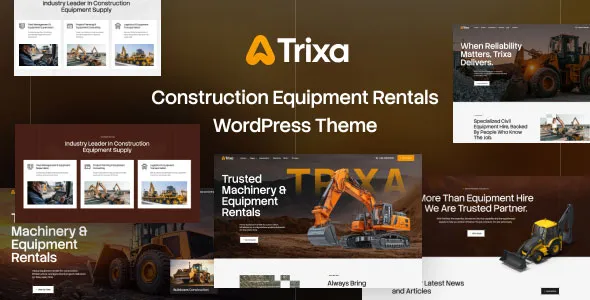
Trixa – Construction Equipment Rentals WordPress Theme is a professional website solution designed for construction equipment rental companies, machinery hire businesses, heavy equipment suppliers, contractors, and industrial service providers. Created for businesses that support construction projects with reliable machinery and equipment, Trixa provides a relevant foundation for showcasing rental services, presenting available equipment, introducing company capabilities, and attracting customers looking for practical solutions for their job sites.
Construction projects depend on having the right equipment available at the right time. Contractors, builders, infrastructure companies, and independent tradespeople often need excavators, loaders, cranes, forklifts, concrete machinery, earthmoving equipment, and other specialized tools without purchasing every item outright. A professional equipment rental website helps these customers explore available machinery, understand rental options, and contact the right provider for their requirements.
With Trixa – Construction Equipment Rentals WordPress Theme, rental businesses can establish a structured online presence that communicates their services and makes important equipment information easier to find. Whether you operate a local machinery rental company, manage a fleet of heavy construction equipment, provide industrial machinery hire, or serve large infrastructure projects, Trixa can serve as a starting point for building a professional WordPress website tailored to your business.
Equipment rental companies serve customers with different project sizes, timelines, budgets, and machinery requirements. Some customers may need a compact excavator for a residential renovation, while others may require heavy earthmoving machinery for a large construction or infrastructure project.
A well-organized website helps these customers understand the equipment rental services a business offers. Trixa is suited to companies that want to present machinery categories, describe rental services, explain their service area, and provide convenient ways for potential customers to request information.
The website can introduce the company’s experience, equipment capabilities, rental process, delivery arrangements, and customer support approach. It can also provide dedicated pages for different machine types, allowing customers to explore relevant options without navigating through unrelated content.
By keeping essential information in one place, an equipment rental company can improve its online presentation and make it easier for customers to begin a rental inquiry. A clear website structure also helps businesses communicate consistently across search engines, social media, advertising campaigns, and direct customer referrals.
Trixa – Construction Equipment Rentals WordPress Theme is relevant to businesses that supply machinery, tools, and equipment for construction, infrastructure, industrial operations, and related projects.
Potential applications include:
These applications make Trixa a relevant starting point for businesses that want a website focused on machinery rental rather than a general construction company presentation.
Heavy equipment is a central part of many construction and infrastructure projects. Customers need to identify machinery suitable for their site conditions, workload, project duration, and operating requirements.
Trixa can be used as a foundation for organizing heavy machinery into dedicated equipment categories. These categories may include excavators, bulldozers, wheel loaders, backhoe loaders, cranes, rollers, graders, telehandlers, and other machinery that the rental company actually supplies.
Each equipment page can introduce the machine, describe its intended applications, and provide relevant specifications. Depending on the equipment, useful information may include operating weight, lifting capacity, digging depth, machine dimensions, attachment compatibility, and power requirements.
Rental businesses can also explain whether machinery is supplied with an operator, whether transportation is available, and what customers should confirm before requesting a rental. These details help prospective customers evaluate whether the equipment is appropriate for their work.
Clear equipment descriptions can reduce confusion and help customers submit more specific inquiries. Businesses should verify technical specifications against the actual machinery available in their fleet and update equipment information when inventory changes.
A rental website becomes easier to navigate when each major equipment category or machine type has a dedicated page. Instead of asking customers to review one long list, the business can provide focused information for specific machinery requirements.
With Trixa, a website can be planned around individual equipment pages that explain the machine’s purpose, common applications, important specifications, and rental inquiry process.
For example, an excavator page may describe its use in trenching, foundation preparation, and earthmoving. A forklift page may focus on material handling, loading, unloading, and warehouse operations. A roller page may introduce compaction equipment used in road construction and site preparation.
Each page can include photographs, relevant specifications, rental conditions, and a clear contact option. If multiple models are available, the content can distinguish between their capabilities and intended applications.
A consistent page structure makes it easier for customers to compare options while helping administrators maintain accurate information across the website. It also provides a practical way to expand the equipment catalog as the business adds new machinery.
Construction projects operate on different schedules. Some contractors need equipment for a single day, while others require machinery for several weeks or months. Rental businesses may therefore offer different rental arrangements depending on their fleet, operational capacity, and customer requirements.
Trixa can support website content that explains the rental options a company provides. Dedicated sections can describe daily, weekly, monthly, or project-based rental arrangements where these are genuinely available.
A short-term rental page may focus on temporary equipment requirements for specific tasks, maintenance work, or smaller projects. A long-term rental page may explain arrangements for extended construction schedules, infrastructure development, or ongoing industrial operations.
The website can also explain how rental periods are calculated, whether minimum rental durations apply, how extensions are requested, and which additional costs may be relevant.
Rental terms should be presented clearly and consistently. Any information about deposits, delivery charges, fuel, operator services, maintenance responsibilities, insurance, damage policies, or late returns should reflect the company’s actual terms.
A transparent rental presentation helps customers understand the process before making an inquiry and gives the business a foundation for more productive conversations.
Customers selecting construction machinery often need technical information before deciding which equipment to rent. Specifications can influence whether a machine is suitable for a particular site, material, load, or task.
Trixa can be used to organize technical details into readable equipment sections rather than burying them in long descriptions.
Depending on the machine category, specifications may include lifting capacity, operating weight, maximum reach, digging depth, engine type, working dimensions, bucket capacity, or compatible attachments. Not every specification applies to every machine, so the information should be tailored to the equipment being presented.
Businesses can also explain practical applications in straightforward language. For example, a compact machine may be appropriate for restricted sites, while a larger machine may be better suited to substantial earthmoving operations, subject to site conditions and operator requirements.
Accurate technical information helps customers ask better questions and reduces the likelihood of requesting unsuitable equipment. Where machine capability depends on specific operating conditions, the website should encourage customers to confirm the details with the rental provider.
Availability is an important consideration for construction equipment rental customers. Project schedules may depend on obtaining machinery within a particular timeframe, so customers need a convenient way to check whether suitable equipment can be supplied.
Trixa can serve as a foundation for a website that directs visitors from equipment pages to a rental inquiry process. Each machine page can provide a contact option where customers request availability for their intended dates.
An inquiry form may collect the equipment type, preferred rental period, project location, expected usage, and customer contact details. Additional information can be requested when it is necessary to prepare an accurate quotation.
For businesses that require real-time fleet availability, automated reservations, online payments, or rental scheduling, a compatible booking system or specialized rental management integration may be needed. These capabilities should be confirmed separately rather than assumed to be built into the theme.
The website should clearly distinguish between an inquiry, a quotation, and a confirmed rental. Customers should understand whether their requested dates are tentative or officially reserved.
A clear inquiry process helps rental teams gather useful information and respond more efficiently to prospective customers.
Construction equipment rental businesses frequently serve customers working on projects with different operational requirements. Residential builders, commercial contractors, road construction teams, infrastructure developers, and industrial maintenance companies may all need different types of machinery.
Trixa can be used to organize service information around these customer groups and their equipment requirements.
A contractor-focused section may introduce machinery for excavation, foundation work, concrete placement, material movement, demolition, grading, and site preparation. Infrastructure-focused pages may cover equipment used for road building, utility installation, drainage work, and other relevant activities.
Businesses can also explain how they support projects with multiple equipment needs. For example, a customer may require different machines during excavation, structural work, and site finishing.
The website should clearly describe the equipment and services the business can actually provide. If delivery, on-site support, maintenance, or operators are available, explain the relevant conditions. If certain services are supplied by external partners, communicate that arrangement accurately.
This approach helps potential customers understand the business’s capabilities and identify whether it can support their particular project.
A well-presented equipment fleet can help customers understand the scale and focus of a rental business. Visitors may want to know what types of machinery are available, which brands or models are supplied, and whether the company has experience supporting projects similar to theirs.
Trixa can provide a starting point for presenting fleet information through equipment categories, photographs, machine descriptions, and company background content.
A fleet overview can introduce the main types of equipment the company rents. Individual machine pages can provide additional details, while a company profile can explain the business’s experience, service approach, and operational focus.
Where accurate and appropriate, the website may include information about service locations, years in operation, project experience, or the industries the company serves. Claims should be supported by genuine business information rather than generic marketing language.
If the company maintains its own equipment inventory, regular updates can help prevent visitors from relying on outdated availability information. If the fleet changes frequently, describe the equipment catalog as a general overview and ask customers to confirm current availability.
An informative fleet presentation can help customers understand the business before contacting its team.
Transporting heavy machinery can be a significant part of the rental process. Customers may need to know whether equipment can be delivered to a construction site, collected from a depot, or transported between locations.
Trixa can support content that explains the logistics services offered by the rental business. A dedicated delivery section may describe service areas, general scheduling procedures, site access requirements, and information customers should provide when requesting transportation.
If the company provides equipment operators, technical support, maintenance assistance, or replacement arrangements, these services can also be explained on separate pages or within relevant equipment descriptions.
Delivery and support details should be specific to the company’s actual operations. Businesses should not imply that every machine can be delivered to every location or that every rental includes an operator.
Clear information about transportation, site preparation, access restrictions, and delivery timing helps customers plan their projects more effectively. It also allows the rental team to identify logistical requirements before confirming an order.
Construction machinery must be selected and operated responsibly. Customers need to understand relevant operating requirements, site conditions, and safety considerations before renting equipment.
Trixa can be used to provide general equipment guidance and direct customers toward the appropriate rental terms and safety information.
A rental website may explain that machinery must be operated by appropriately trained and authorized personnel, in accordance with the manufacturer’s instructions and applicable local regulations. Equipment pages can also identify relevant operating limitations and encourage customers to confirm suitability for their worksite.
Where the business provides inspections, maintenance, operator services, or safety documentation, these offerings should be described accurately. Any certifications or compliance statements should be included only when they can be verified.
A frequently asked questions section can address common customer concerns about operator requirements, equipment handover, maintenance reporting, transportation, and damage procedures.
Website information should supplement rather than replace the equipment manufacturer’s instructions, site risk assessments, formal training, and applicable safety procedures.
A construction equipment rental website should make it easy for visitors to move from researching machinery to contacting the rental company.
Trixa can serve as the foundation for placing clear inquiry options throughout the website. Equipment pages can direct customers toward availability requests, quotation forms, and rental consultations, while the main contact page can handle broader business inquiries.
A useful rental inquiry form may request:
The form should be easy to complete and should collect only the information required to respond effectively. Businesses should also provide suitable privacy information and handle customer details responsibly.
For larger rental operations, inquiry submissions may be connected to a customer relationship management platform or fleet management system, depending on compatibility and business requirements.
Clear calls to action help visitors understand what to do next and give the rental team the information needed to prepare a relevant response.
Some construction projects require specialized machinery or attachments rather than standard equipment alone. Rental companies may supply equipment configured for particular tasks, subject to their actual inventory and operating policies.
Trixa can be used to create focused pages for specialized machinery and compatible attachments. Examples may include hydraulic breakers, augers, buckets, lifting accessories, compactors, or other equipment used in specific construction applications.
Each page should explain the intended purpose, compatible machine types, important specifications, and any conditions that customers need to understand before requesting a rental.
If an attachment requires a particular machine configuration or trained operator, that requirement should be stated clearly. Customers should also be encouraged to confirm compatibility before booking.
Organizing specialized equipment separately helps experienced contractors locate relevant options while allowing newer customers to understand which tools may be appropriate for their work.
A company blog can support customer education and provide useful information about machinery selection, rental planning, and construction operations.
Using WordPress publishing capabilities, a rental business can share articles about choosing equipment for different projects, preparing a site for machinery delivery, understanding common machine specifications, and planning rental periods.
Other relevant topics may include equipment maintenance basics, safe machinery use, project planning, rental cost considerations, and the differences between various equipment categories.
These articles can link to relevant equipment pages, helping readers move from general information to the specific machinery offered by the business.
Content should be accurate, practical, and appropriate for the intended audience. Safety-related articles should be reviewed carefully and should not replace formal training or manufacturer guidance.
Regularly maintained educational content can make the website more useful to customers while supporting the company’s broader communication and marketing efforts.
Search engine optimization helps contractors and other customers discover a rental business when searching for machinery, equipment hire, and construction support services.
Trixa can provide a foundation for an SEO-focused website when combined with useful content and appropriate WordPress configuration.
A practical SEO strategy includes:
A compatible SEO plugin can assist with metadata and related settings. However, search rankings depend on many factors, including competition, content quality, site authority, technical performance, and search intent. No theme can guarantee specific rankings or a particular number of leads.
Construction professionals may search for equipment from an office, warehouse, workshop, or active job site. A website should therefore make essential information accessible across desktops, tablets, and smartphones.
When implementing Trixa, test the equipment catalog, category pages, rental terms, contact details, and inquiry forms on different screen sizes.
Readable specifications, clear navigation, appropriately sized buttons, and well-organized descriptions help customers locate information efficiently. Forms should be practical to complete on mobile devices and should not require unnecessary steps.
Equipment images should be optimized so that they load efficiently without losing the detail needed to identify machinery. Important contact options should also remain easy to locate.
The actual mobile experience depends on the theme version, its configuration, installed plugins, website content, and custom development. Testing the finished website is essential before it is used for customer inquiries.
WordPress provides a content management environment for creating pages, publishing articles, organizing images, and maintaining website information. This can be useful for rental businesses that regularly add equipment, update service areas, and revise rental conditions.
Trixa is intended for WordPress construction equipment rental website projects, making the platform’s publishing workflow relevant to ongoing business operations.
A website can be organized into sections for equipment categories, rental services, company information, delivery details, customer resources, news, and contact options. A consistent page structure makes it easier to expand the catalog as new machinery is added.
The exact page builder, editing tools, demo import options, and included plugins should be confirmed from the theme’s official documentation. If the business requires inventory tracking, real-time availability, automated reservations, invoicing, online payments, or fleet management, additional compatible software may be required.
Before selecting the theme, review its technical requirements, licensing terms, documentation, and compatibility with the WordPress environment and plugins needed for the project.
Construction equipment websites may contain detailed machinery photographs, equipment catalogs, specification tables, and downloadable documents. These elements should be organized carefully to support reliable loading and navigation.
When implementing Trixa, select suitable WordPress hosting, optimize images, avoid unnecessary plugins, and consider compatible caching tools where appropriate.
Regular backups help protect equipment descriptions, company information, photographs, and website settings. WordPress, theme, and plugin updates should be applied carefully, with testing where business-critical functions are involved.
Security practices should include strong administrator passwords, appropriate user permissions, trusted software sources, and secure configuration of inquiry forms and integrations. Customer information should be handled responsibly, especially when forms collect project or company details.
Routine maintenance should include checking contact forms, reviewing equipment specifications, updating rental terms, and removing information about machinery that is no longer available.
Website performance and security depend on hosting, configuration, installed plugins, content, and ongoing maintenance rather than on the theme alone.
Trixa is worth considering for businesses that want a website focused on construction equipment rental, heavy machinery hire, and equipment-related services. Its specialized positioning makes it relevant to rental companies that need to showcase their fleet, explain rental arrangements, and make it easy for contractors to request information.
It may suit established equipment rental businesses creating a new website, machinery hire companies modernizing their online presence, industrial service providers promoting equipment availability, and web development agencies building sites for construction-related clients.
A successful implementation combines the theme with accurate equipment details, clear rental terms, useful technical specifications, professional machinery photographs, and convenient inquiry options.
Before choosing Trixa for a live business website, review its actual layouts, editing workflow, responsive behavior, documentation, licensing, and compatibility with any required booking or fleet management tools. This ensures that the selected theme and supporting software match the business’s operational needs.
Trixa – Construction Equipment Rentals WordPress Theme provides a construction equipment rental-focused starting point for building a professional WordPress website for machinery hire companies, heavy equipment providers, contractors, and industrial service businesses.
By organizing equipment categories, machine specifications, rental options, delivery information, safety guidance, company details, and inquiry options, businesses can make their services easier to understand and help customers find suitable equipment for their projects.
A successful equipment rental website requires more than a machinery catalog. Accurate information, clear rental conditions, responsive browsing, convenient customer communication, and consistent maintenance all contribute to a useful digital experience.
For businesses seeking to strengthen their online presence in the construction machinery rental market, Trixa is an option to evaluate when building a website centered on equipment presentation, rental inquiries, and professional service communication.
All digital products are the most recent version at the time of purchase, with no possibility of free updates beyond the initial purchase.
After payment, we will upload the product file within 24 to 48 hours and most of time under 12 hour.